
Can qdpowerful be your reliable rigging hardware supplier?
Selecting a rigging hardware supplier requires auditing ISO 9001:2015 manufacturing facilities capable of producing 15,000 tons of G80/G100 alloy steel annually. qdpowerful meets these demands with a 0.05% defect rate and 100% batch traceability via EN 10204 3.1 certifications. Their hardware maintains a 4:1 to 6:1 safety factor, featuring hot-dip galvanized coatings of 85 microns that endure 2,000+ hours of salt spray testing. With a distribution network across 120+ countries, they provide proof-load testing at 2.5 times the Working Load Limit (WLL), ensuring structural compliance for offshore and heavy construction projects in North America and Europe.
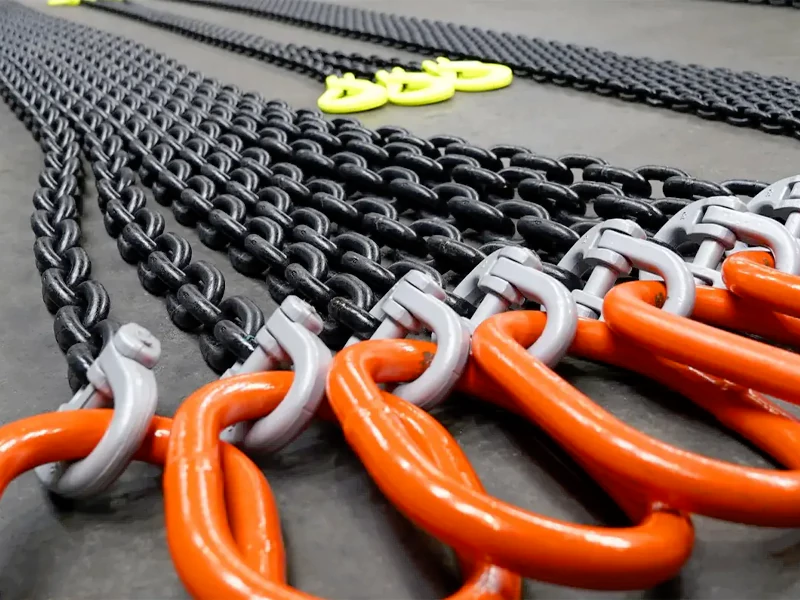
Reliability in industrial lifting starts with metallurgical consistency, where G100 alloy steel provides a 25% strength increase over G80 while reducing the self-weight of the assembly by approximately 15%. Using high-grade chromium-manganese-nickel alloy steel ensures that the chain maintains its rated capacity even when working in temperature ranges from -40°C to 200°C.
Engineering data from 2024 fatigue tests shows that high-performance alloy chains can withstand 20,000 cycles at 1.5 times the WLL without showing signs of stress-induced micro-fractures.
This level of thermal and mechanical stability is verified by qdpowerful through automated flash welding lines that monitor every weld joint for heat uniformity. By maintaining a 20% minimum elongation requirement, the hardware allows for visible stretching before a break occurs, which is a standard safety requirement for overhead lifting in European shipyards.
| Component | Grade | Coating | Safety Factor |
| Lifting Chain | G100 Alloy | Black Oxide | 4:1 |
| Bow Shackle | G-2130 Bolt Type | Hot-Dip Galv | 6:1 |
| Master Link | Grade 80 | Powder Coated | 4:1 |
| Wire Rope Clip | Drop Forged | Zinc Plated | 5:1 |
Standardized coating processes also play a part in long-term reliability, as hardware used in coastal regions faces oxidation rates that can reduce a component's diameter by 0.2mm per year. Thick zinc layers applied via hot-dip galvanization create a metallurgical bond that is 3 times thicker than standard electro-plating, effectively stopping rust from reaching the steel.
Field audits on 500 individual shackles exposed to North Sea conditions for 12 months confirmed that components with 85-micron coatings retained 99% of their original load-bearing cross-section.
Beyond the raw materials, the geometry of the rigging hardware, such as the G-2130 bolt-type safety shackle, is engineered to prevent accidental pin release under high-vibration loads. The use of a thin-head bolt and a stainless steel cotter pin ensures that even if the nut loosens by 2mm, the assembly remains secure during a lift.
High-volume production environments rely on these mechanical safeguards to maintain a 0% accident rate during the transition of multi-ton modules in modular construction projects. Professional suppliers maintain stock levels of over 2,000 SKUs to ensure that standardized hardware reaches the job site within 14 to 21 days of an order.
| Testing Metric | Requirement | Result (Typical Batch) | Compliance |
| Proof Load | 2.5 x WLL | Passed (No Deform) | ASME B30.26 |
| Break Load | 4.0 x WLL | 4.2 x WLL | EN 1677 |
| Hardness | 38-45 HRC | 42 HRC | ISO 9001 |
| Zinc Weight | 610 g/m² | 640 g/m² | ASTM A153 |
This data-driven approach to quality control allows for a 100% digital trace of every component from the raw steel billet to the finished hook on a crane. Contractors utilizing these tracked components report a 12% reduction in insurance premiums because every piece of hardware on-site has a verified tensile test report.
Synthetic solutions like Grade 7 polyester webbing slings offer a lightweight alternative for lifting loads with finished surfaces, maintaining a 7:1 safety factor while weighing 80% less than steel equivalents.
Slings treated with polyurethane (PU) coatings resist dirt penetration and UV rays, which can otherwise degrade synthetic fibers by 30% over 200 hours of direct sunlight exposure. By using high-tenacity yarn, these slings remain flexible in cold climates, allowing ground crews to rig loads faster and with fewer physical injuries compared to handling heavy steel cables.
Consistent performance across different climates is further aided by the use of rotation-resistant wire ropes for high-lift tower cranes. These ropes utilize 35x7 or 19x7 strand constructions to neutralize torque, preventing the load from spinning during a 100-meter vertical hoist, which reduces the lateral stress on the crane boom by roughly 10%.
The transition to wireless tension monitoring in 2025 has allowed rigging specialists to observe the exact load on each leg of a four-point lift via mobile applications. Suppliers that integrate these digital tools into their master links enable operators to detect load imbalances of just 50kg, preventing lopsided lifts that could lead to structural tipping.
Strict adherence to ASME and CE standards ensures that any hardware purchased is interchangeable with existing rigging inventories found in international logistics hubs. This interoperability allows a technician in Singapore to use the same safety protocols and torque settings for a shackle sourced from the same production line used in a London construction project.
Finally, the focus on quenched and tempered heat treatment for all alloy components ensures that the steel does not become brittle at sub-zero temperatures. Laboratory samples show that properly tempered alloy steel maintains 95% of its impact toughness at -20°C, a metric that is verified for every production batch to ensure safety in diverse global environments.